Posts

Agression :A poem by Dr Mukesh Pareek

Image
It is very simple to be agressive           when You are slightly in the advantage You are towards the biased side of increasing digits of all sorts. You are agressive               when You have nothing to stake for, Nothing to lose and lament over. Agression has you entirely  when.  ...........    You are a husband or a teacher or a saler Your agression is less a matter of trauma and testetorone. Your agression is more political than mine Mr. Man. Your agression has stood because I have withstood it with my concern for you. I am not agressive      when I feel I might hurt you. I might lose you. I might disturb you. I am agressive with reasons only stones know. I am agressive with reasons only my heart senses. Agression has his house in hubris. And I am homeless......  Dr Mukesh Pareek 

Wilderness:A Poem by Dr Mukesh Pareek

Image
Wilderness....... It stirs there..... in the centre of our hearts skulking, snarling, sneering at the cruel savagery of the softskilled smiles. Wilderness........ It pervades here...... in the learned and uncanny gestures of couth youth designed to tread rough shod. Wilderness........ It echoes all euphoniously now...... where unsuspecting hearts beat at the finetuned rimes of fickle minded blokes.  Wilderness........ It lurks right in the tensed and ecstatic faces of a crazy crowd lost in the maniac cheers. Wilderness....... It is savagely felt in the crowded shrines where a lost mankind searches solace from self born diseases of soul. Dr Mukesh Pareek 

Foucauldian concept of Biopower and Governmentality explained by Dr Mukesh Pareek

Image
Biopower is a term coined by Michel Foucault to refer to a form of power that is exercised over the bodies and lives of individuals and populations. It involves the use of power to regulate and control biological processes such as birth, death, health, and reproduction.  According to Foucault, biopower represents a shift in the way power operates in modern societies. In the past, power was primarily exercised through physical violence or the threat of it. However, modern societies have developed subtle and more pervasive forms of power that operate through the management and regulation of bodies and populations. Biopower involves the use of disciplinary and regulatory techniques to manage populations such as surveillance, classification, normalization, and control of access to resources. These techniques are used to ensure social stability and promote the interests and values of those in power, often at the expense of the underprivileged and marginal groups in society. ...

Role of Discourse in the formation of subjectivity according to Michel Foucault

Image
Role of Discourse in the formation of subjectivity according to Michel Foucault  DISCOURSE ACCORDING TO FOUCAULT  In the simplest terms, discourse according to Michel Foucault refers to a system of language and communication that shapes and regulates the way individuals think and behave. It defines and limits what can be said, by whom, and in what context, and establishes what is considered acceptable, valid, and normal within a given social and cultural context. Discourse is not just about individual words or statements, but about the broader practices, institutions, and knowledge that shape our understanding of the world. It plays a significant role in power relations within society by enforcing certain knowledge and modes of thinking, while excluding and marginalizing others. According to Michel Foucault, discourse plays a significant role in the formation of subjectivity. Foucault's concept of discourse goes beyond language and communication. It refers to a bro...

A Long Quiz on Afro American Literature by Dr Mukesh Pareek

Image
 -  A long quiz on Afro-American literature  1.Who is the author of the novel "Beloved," which won the Pulitzer Prize for Fiction in 1988? 2.Langston Hughes, one of the leading figures of the Harlem Renaissance, is known for his poetry that often incorporates which musical genre? 3.Who wrote the acclaimed autobiography "The Autobiography of Malcolm X," which chronicles his journey from a troubled youth to becoming a prominent civil rights activist? 4.Which African-American writer, poet, and civil rights activist penned the collection of essays titled "The Fire Next Time"? 5.Zora Neale Hurston's novel "Their Eyes Were Watching God" explores the life and experiences of which African-American woman in the early 20th century? 6.Who wrote the play "A Raisin in the Sun," which portrays the struggles of a Black family living in Chicago's South Side? 7.The poem "Still I Rise" is a powerful and empowering work by wh...

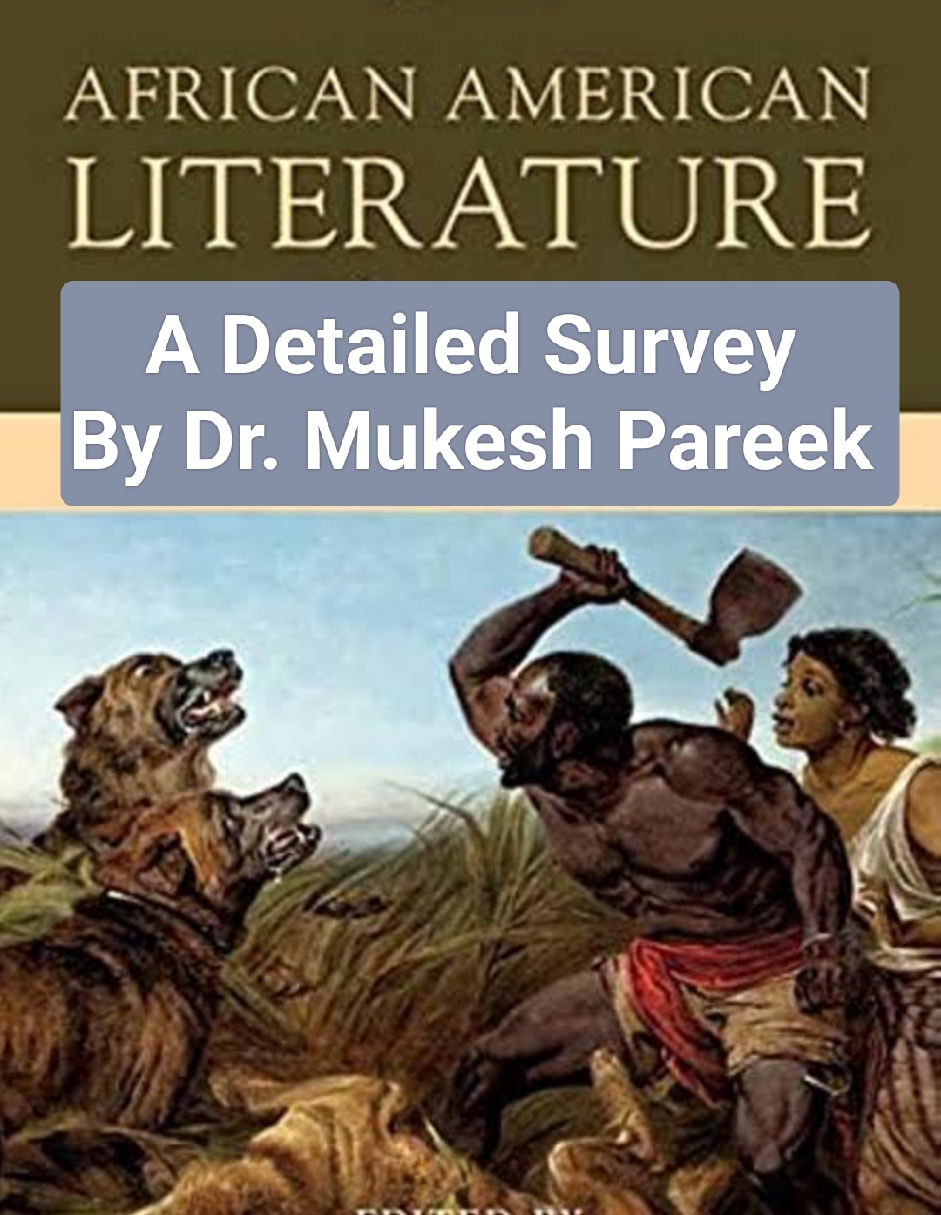
AFRO -AMERICAN LITERATURE:A DETAILED SURVEY by Dr. Mukesh Pareek

Image
Afro-Am Writers: Rich Legacy Afro-American writers, also known as African-American writers, have made significant contributions to American literature throughout history. These writers, hailing from diverse backgrounds and experiences, have explored the African-American experience, identity, culture, and history in their works. Their writings have not only enriched the literary landscape but also provided valuable insights into the struggles, triumphs, and aspirations of African Americans in the United States. In this write-up, we will delve into the rich legacy of Afro-American writers, highlighting some key figures and their notable works. The origins of Afro-American literature can be traced back to the 18th century when African slaves, forcibly brought to America, began expressing their experiences through oral storytelling, folktales, and spirituals. These narratives, rooted in the African oral tradition, served as a form of resistance and community-building in the face of slavery...

The Art of Gnawing by Mukesh Pareek

Image
Gnawing.... is an art unadorned Failure gnaws visibly,  Envy gnaws sneakily,  Lust gnaws impatiently,  Success too has learnt gnawing of late It gnaws happily.  This artistic baroque gnawing has made man a sounding vessel Sans virility, sans vitality, sans guts Gnawing is a doctorate in hiding truth.  It is an expert in the veneer of panache I confess......   Gnawing hurts. Dr Mukesh Pareek 

An Article on Indian Dalit Writers by Dr Mukesh Pareek

Image
Indian Dalit writers are truly inspiring individuals who have fearlessly raised their stultified voices to bring attention to social injustices and caste discrimination. One prominent figure in this sphere is B.R. Ambedkar, who not only fought for the rights of Dalits but also made significant contributions to Indian literature. Dalit literature emerged as a powerful literary movement in the mid-20th century, aiming to represent the experiences and struggles of Dalits through the written word. This movement has given rise to a plethora of talented Dalit writers who courageously challenge societal norms and advocate for equality. Dalit as a lexis item: In the late 1880s, the Marathi word 'Dalit' was  first used by Mahatma Jotiba Phule for the outcasts and Untouchables that were oppressed and on the brink of extreme and severe marginalised in the Hindu society.  Dalit is a vernacular form of the Sanskrit दलित (dalita) . In Classical Sanskrit, this means "divided,...

Memories:A Poem by Dr Mukesh Pareek

Image
My being suspends with uninvited yet persistent recallings Often, the intruders cavil and call out my left over shreds of me Liars,I name these uncalled for hiccups For their solace spurts my frame with pitious punctures in my soul Ah me! Choice is an iron jacket all wears inside My shreds and failing willings no more wish them You gate crashers, stop luring me in a hallucination I have learnt to breath in the tight, stiff air Don't mislead my composure now Go,you wandering hobgoblins of yore Let me check in me with a self. Dr Mukesh Pareek 

Fabula Palliata : The Greek plays adapted in Latin

Image
Fabula Palliata    is any of the Roman comedies that were translations or creative adaptations of Greek dramas especially comedies.  The name  Palliata has been derived from the Latin word  pallium which means  a Greek cloak . All surviving Roman comedies composed by Plautus  and Terence belong to this category.  So from within the fold of the fabula palliata, different situations within the Roman context were brought to the fore. The references to Greek places or contexts was interesting as it allowed the audience to accept the subversive elements in the plays as they watched under the illusion that this was happening, say in Athens. But, the situations, humour, context was that of Rome. Moreover, the audience would have understood these plays as Roman plays, remaining unfamiliar with their Greek originals, an idea that critics have often pointed out. As a result, the audience sees a confluence of varied ...

Today's Question

Arrange the following words of Chomsky in chronological order in which they appeared: (i) Current issues in Linguistic Theory (ii) Syntactic structures (iii) Conditions on transformations (iv) Aspects of the theory of syntax Codes: (A) (ii), (i), (iv), (iii) (B) (i), (iii), (iv), (ii) (C) (ii), (iv), (i), (iii) (D) (i), (iv), (ii), (iii) Answer:  (A) Dr Mukesh Pareek's COSMOS JAIPUR since 2000 Contact 9828402032

Today's Question

Arrange the following words of Chomsky in chronological order in which they appeared: (i) Current issues in Linguistic Theory (ii) Syntactic structures (iii) Conditions on transformations (iv) Aspects of the theory of syntax Codes: (A) (ii), (i), (iv), (iii) (B) (i), (iii), (iv), (ii) (C) (ii), (iv), (i), (iii) (D) (i), (iv), (ii), (iii) Answer:  (A) Dr Mukesh Pareek's COSMOS JAIPUR since 2000 Contact for English Literature NET and Notes 9828402032

Today's Question

Image
Assertion (I): Diachronic linguistic deals with changes over time. Assertion (II): Historical linguistics deals with the nature of change in languages in general. (A) Both (I) and (II) are true. (B) Both (I) and (II) are false. (C) (I) is true and (II) is false. (D) (I) is false and (II) is true. Answer:  (A) Dr Mukesh Pareek's COSMOS JAIPUR since 2000. Contact for ENGLISH LITERATURE COACHING and NOTES 9828402032

Today's Question

Assertion (I): Diachronic linguistic deals with changes over time. Assertion (II): Historical linguistics deals with the nature of change in languages in general. (A) Both (I) and (II) are true. (B) Both (I) and (II) are false. (C) (I) is true and (II) is false. (D) (I) is false and (II) is true. Answer:  (A) Dr Mukesh Pareek's COSMOS JAIPUR since 2000. Contact for English Literature NET Coaching and Notes  9828402032

Today's Question

Image
The term ‘Generative grammar’ means: (i) An explicit grammar (ii) A grammar which generates all and only the correct structures of a language on the basis of small number of linguistics units and rules. (A) Only (i) is true. (B) Only (ii) is true. (C) Both (i) and (ii) are false. (D) Both (i) and (ii) are true. Answer:  (D) Dr Mukesh Pareek's COSMOS JAIPUR since 2000. Contact for ENGLISH LITERATURE NET COACHING and NOTES 9828402032

Today's Question

Image
Choose the correct order: (A) Semantics – Phonology – Syntax – Morphology (B) Phonology – Morphology – Semantics – Syntax (C) Phonology – Morphology – Syntax – Semantics (D) Morphology – Syntax – Semantics – Phonology Answer:  (C) Dr Mukesh Pareek's COSMOS JAIPUR since 2000 Contact for NET ENGLISH LITERATURE COACHING and NOTES 9828402032

English Literature NET Paper 2021 June Second Shift solved by Dr Mukesh Pareek

Image
UGC NET 2021 English Shift 2   A Read the following passage and answer the questions that follow:  [T]he aim of all solitude...is the same: to live more at leisure and at one’s ease. But people do not always look for the right way. Often they think they have left business, and they have only changed it. There is scarcely less trouble in governing a family than in governing an entire state: whatever the mind is wrapped up in it, it is all wrapped up in it, and domestic occupations are no less importunate for being less important. Furthermore, by getting rid of the court and the marketplace we do not get rid of the principal worries of our life....Ambition, avarice, irresolution, fear and lust do not leave us when we change our country....They often follow us even into the cloisters and schools of philosophy. Neither deserts, nor rocky caves, nor hair shirts, nor fastings will free us of them. ‐‐ Michel de Montaigne,  “Of solitude” 1. Which of the following best...